How to calculate your MAS: methods, tests and training applications
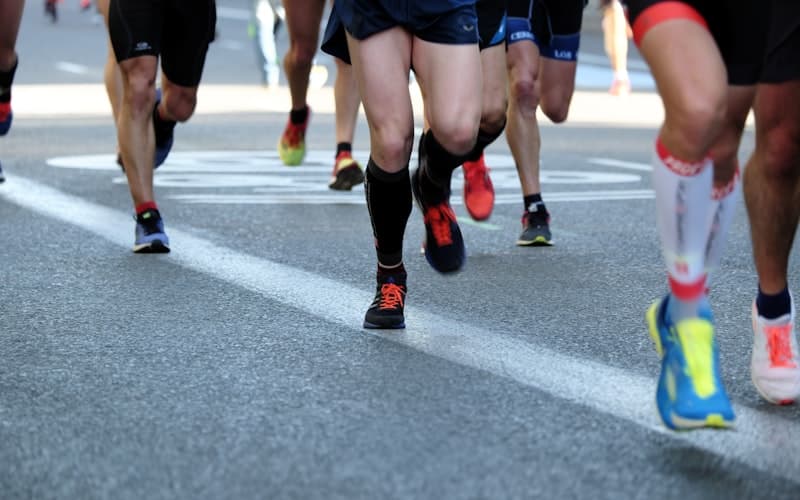
MAS (Maximal Aerobic Speed), known as VMA in French-speaking countries, is one of the most important metrics for any runner looking to improve. It represents the speed at which your oxygen consumption reaches its maximum (VO2max). Knowing your MAS allows you to precisely calibrate your training paces and set realistic race goals.
What exactly is MAS?
MAS is the running speed reached when your body consumes the maximum possible amount of oxygen. Beyond this intensity, the anaerobic system takes over and oxygen debt accumulates rapidly. Most runners can sustain MAS for 4 to 8 minutes depending on fitness level.
MAS benchmarks by level: recreational runners (12-16 km/h), experienced runners (17-20 km/h), elite athletes (20+ km/h).
Field tests to measure your MAS
1. The 6-minute test (Half-Cooper)
The simplest approach: run the greatest distance possible in 6 minutes on a flat track. Your MAS is approximately the distance covered divided by 100 and multiplied by 10. Example: 1,500 m in 6 min → MAS ≈ 15 km/h.
2. The VAMEVAL test
A progressive test with markers every 20 m. An audio signal dictates the pace, increasing by 0.5 km/h each minute. The last completed stage corresponds to your MAS. Widely used in clubs, it requires a flat surface and the official audio file.
3. The Léger-Boucher shuttle test (20 m)
Back-and-forth 20 m runs with progressively increasing speed. Popular in schools and sports clubs, this test is reliable but the agility component (turning around) can slightly underestimate the true MAS of distance runners.
4. The Astrand test (3 minutes 30)
After a thorough warm-up, run 3 minutes 30 seconds at maximum sustainable pace. The distance covered, converted to km/h, gives a direct MAS estimate. Shorter than the Half-Cooper, it demands good pace awareness.
Lab test vs field test
A laboratory test on a treadmill with expired gas analysis (ergo-spirometry) is the gold standard. It provides exact VO2max and associated MAS values. However, it costs $100-250 and is less accessible. For most runners, a well-conducted field test provides a sufficiently accurate estimate.
💡 Tip: If you don't have lab access, the Half-Cooper test is the most accessible and reliable. Just ensure the track is flat and properly measured.
Calculating training paces from your MAS
Once you know your MAS, you can determine your training zones:
Z1 — Recovery: 60-70% of MAS. This is the pace for easy jogs and warm-ups — comfortable enough to hold a conversation. For a MAS of 16 km/h: 9.6 to 11.2 km/h.
Z2 — Endurance: 70-80% of MAS. The pace for long runs and steady-state endurance. For a MAS of 16 km/h: 11.2 to 12.8 km/h.
Z3 — Tempo: 80-85% of MAS. The pace for tempo runs and moderate fartleks. For a MAS of 16 km/h: 12.8 to 13.6 km/h.
Z4 — Threshold: 85-90% of MAS. Threshold pace, for sustained efforts and 10K to half-marathon races. For a MAS of 16 km/h: 13.6 to 14.4 km/h.
Z5 — VO2max: 90-100% of MAS. Short intervals (200 m, 300 m, 400 m) and medium intervals (800 m, 1,000 m). For a MAS of 16 km/h: 14.4 to 16 km/h.
Key workouts to develop your MAS
30/30 intervals
30 seconds fast (100-105% MAS) / 30 seconds slow (jog recovery). Complete 10 to 20 reps in 1-2 sets. This is the gold standard workout for MAS development without excessive joint stress.
200 m or 300 m repeats
Short reps at 100-105% MAS with equal-time jog recovery. Ideal for working on running mechanics at high speed.
1,000 m repeats
5 to 8 reps of 1,000 m at 95-100% MAS, with 90 seconds to 2 minutes jog recovery. A demanding session that develops both MAS and endurance.
Estimating race times from MAS
MAS allows you to estimate your potential race times. As a general rule:
10K: ~85-88% of MAS sustained for 35-50 min.
Half-marathon: ~80-85% of MAS for 1h20-2h.
Marathon: ~75-80% of MAS for 2h30-4h30.
These percentages vary depending on your endurance index and experience. A runner with a strong endurance profile will sustain a higher percentage over longer distances.
When to retest your MAS
Retest your MAS every 3 to 4 months, or after a specific training block. Gains are typically rapid in the first few years (1-2 km/h per year) then become more modest as you approach your genetic potential.
Calculate your MAS with RaceDayLab
Our MAS calculator lets you estimate your MAS from test results and instantly compute your training paces. Combine it with the Pacer to get a detailed per-kilometer race plan.
Related articles
Ready to prepare your next race?
Use our free tools: pace calculator, nutrition planner, gear finder.
Calculate my pace