Half marathon training plan: 12-week program
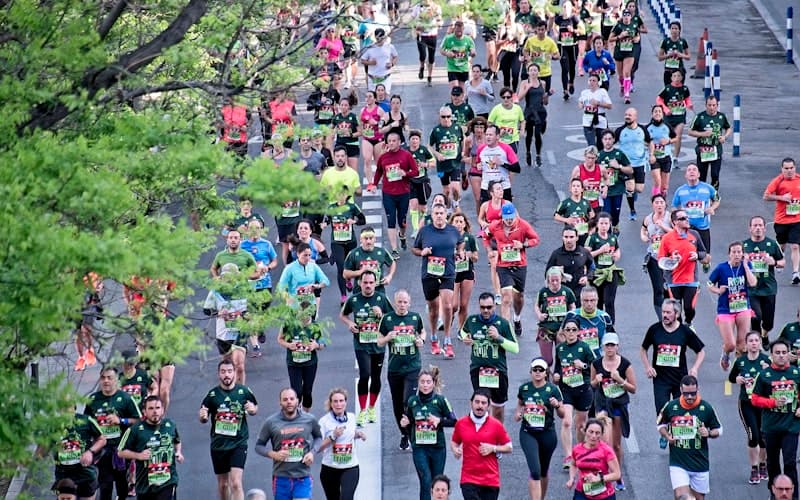
The half marathon (21.097 km / 13.1 miles) is the perfect distance: long enough to be a real challenge, short enough not to destroy your body. Whether you're targeting your first finish or a sub-2-hour time, here's a complete 12-week plan.
Prerequisites
This plan assumes you can already run 30-40 minutes non-stop and have been running at least 2-3 times per week for a few months. If not, start with a base-building plan for 6-8 weeks first.
Plan structure
The plan is organized in 3 phases:
Phase 1: Base building (weeks 1-4)
Building your aerobic foundation. 3-4 runs per week including a progressive long run (10 km → 14 km). Volume goes from 25 to 35 km/week. All runs are at easy pace (you can hold a conversation).
Phase 2: Development (weeks 5-9)
Adding quality workouts. Volume builds to 40-50 km/week. Key sessions:
- Long run: 15 km → 18 km, with the last 5 km at half marathon pace
- Intervals: 6-8 × 1000 m at 10K pace (90s jog recovery)
- Tempo: 2-3 × 3 km at half marathon pace (2 min jog recovery)
- Easy runs: 2 runs at easy pace (45-60 min)
Phase 3: Taper (weeks 10-12)
Reduce volume by 30-40% while maintaining intensity. Last long run (15 km) in week 10. Week 12: 3 short easy runs, rest the day before.
Key takeaway: These three phases progress logically: build your aerobic base, add quality work, then taper to race-ready. Respecting this progression reduces injury risk and maximizes race-day performance.
Finding your target pace
Half marathon pace is between 80-88% of your VO2max pace, or roughly 15-20 seconds slower than your 10K pace.
Examples:
- Target 2:00 → pace 5'41/km → calculate your splits
- Target 1:45 → pace 4'58/km
- Target 1:30 → pace 4'16/km
Race day nutrition
3h before: carb-rich breakfast (white bread, jam, banana). Avoid fiber and fat.
During: one gel at 45 min, a second at 1h15. Drink at aid stations (small sips). For sub-1:45, water alone is enough. Beyond that, add carbs.
After: recovery drink within 30 min, full meal within 2h.
Half marathon nutrition is simple and depends mostly on your estimated finish time. Always test in training rather than discovering race day that a gel doesn't work for you.
The 5 half marathon mistakes
1. Going out too fast
Trap number one. Starting adrenaline masks the real effort. Result: hitting the wall at 15 km. Strategy: run the first 3 km 10 seconds slower than target pace.
2. Testing gear on race day
New shoes = guaranteed blisters. All your equipment should be tested in training.
3. Neglecting recovery
Overtraining is the invisible enemy. One full rest day per week is non-negotiable.
4. Skipping warm-up
10 minutes easy jog + a few progressive strides before the start activates your cardiovascular system and reduces injury risk.
5. Ignoring the weather
In hot weather (> 25°C / 77°F), slow down by 10-15 seconds per km. Hydration becomes critical.
💡 Key insight: Avoiding these 5 mistakes is 80% of the mental game in a half marathon. If you master pacing strategy, gear preparation, recovery between sessions and warm-up, you're already ahead of most runners.
Ready to start?
RaceDayLab offers free half marathon plans, from beginner to expert, with all workouts detailed week by week.
Discover half marathon plans →
To calculate your training paces and splits, use our free pace calculator.
Related articles
Ready to prepare your next race?
Use our free tools: pace calculator, nutrition planner, gear finder.
Calculate my pace